Abstract
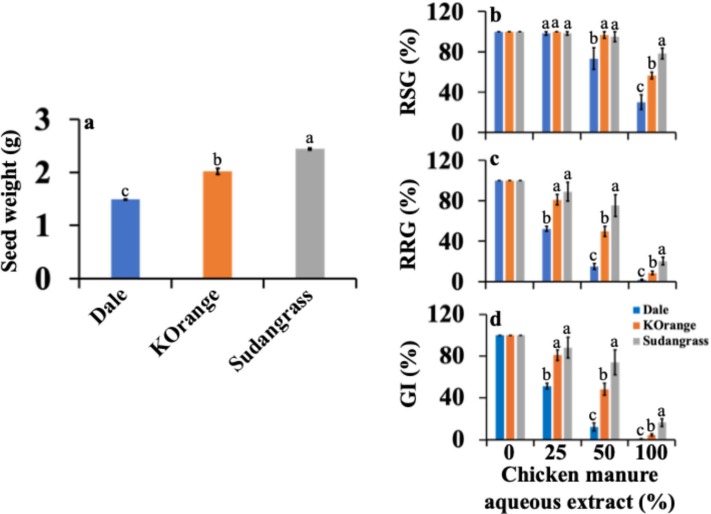
The seed germination test is commonly used to evaluate manure phytotoxicity and ensure it does not contain chemicals detrimental to crops. However, there is no universally recommended model seed for the assay, and results vary depending on the test species used. A better understanding of how seed traits affect response to manure phytotoxicity may help to identify a model seed for the germination assay. Previously, we identified the phytotoxicity of commercial chicken manure to small-seeded plants such as collard greens and mustard, in part due to elevated copper (Cu) levels. We hypothesized that seed size, a major seed trait, may influence the results of manure phytotoxicity tests. To test this hypothesis, we investigated the germination of mustard, sorghum, and sweet corn seeds, representing small, medium, and large seeds, in chicken manure aqueous extracts and in CuCl₂ solutions. The germination indices (GIs) for mustard, sorghum, and sweet corn in chicken manure extract were 0%, 17.2%, and 51.1%, respectively. Additionally, the GIs of sorghum at Cu concentrations of 10, 30, 50, and 100 ppm were significantly higher than those of mustard but lower than those of sweet corn. The GI of the sorghum genotype with smaller seeds was also significantly lower than the genotype with larger seeds, further supporting the hypothesis that seed size influences response to manure phytotoxicity, with larger seeds demonstrating greater tolerance than smaller ones. The results highlight the need to better understand how various seed traits influence germination outcomes to identify model test species for manure phytotoxicity bioassays.